By Deniz Altindag | November 17, 2026
The Invisible Architecture of Sound
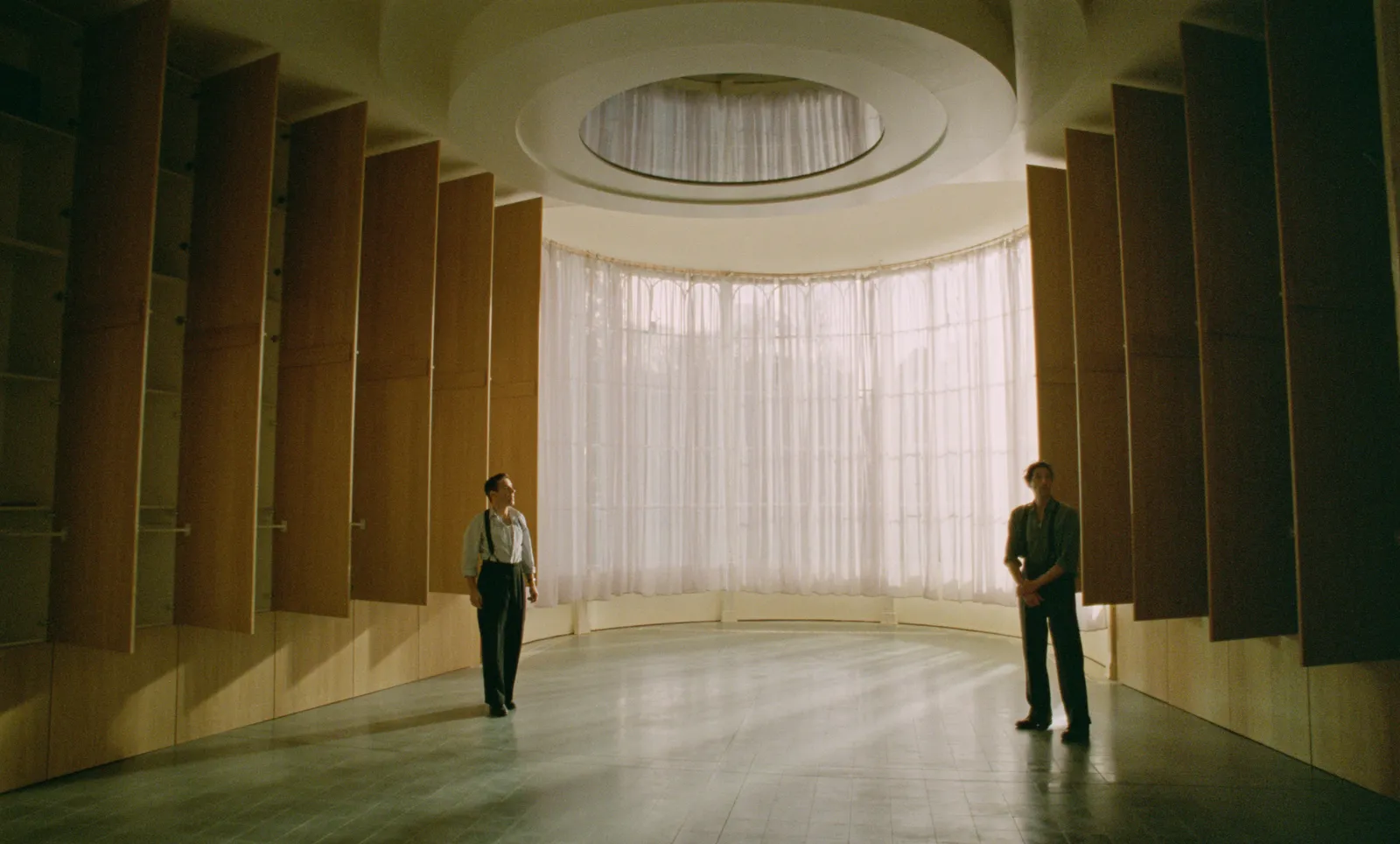
Two people can occupy the same room without sharing the same acoustic space. A conversation can feel private without walls, while a closed room can offer almost no sense of acoustic intimacy. What, then, actually defines the boundaries of architecture?
Architecture is often understood through what can be seen and represented: walls, doors, partitions, plans and sections. Yet the boundaries we experience do not always correspond to the boundaries we see. A room that appears intimate may sound exposed.
A large, open interior may contain pockets of acoustic privacy that remain invisible to the eye. Sound can connect areas that appear separate or create distinct auditory experiences within a visually continuous interior. What we call spatial experience extends beyond what we see.
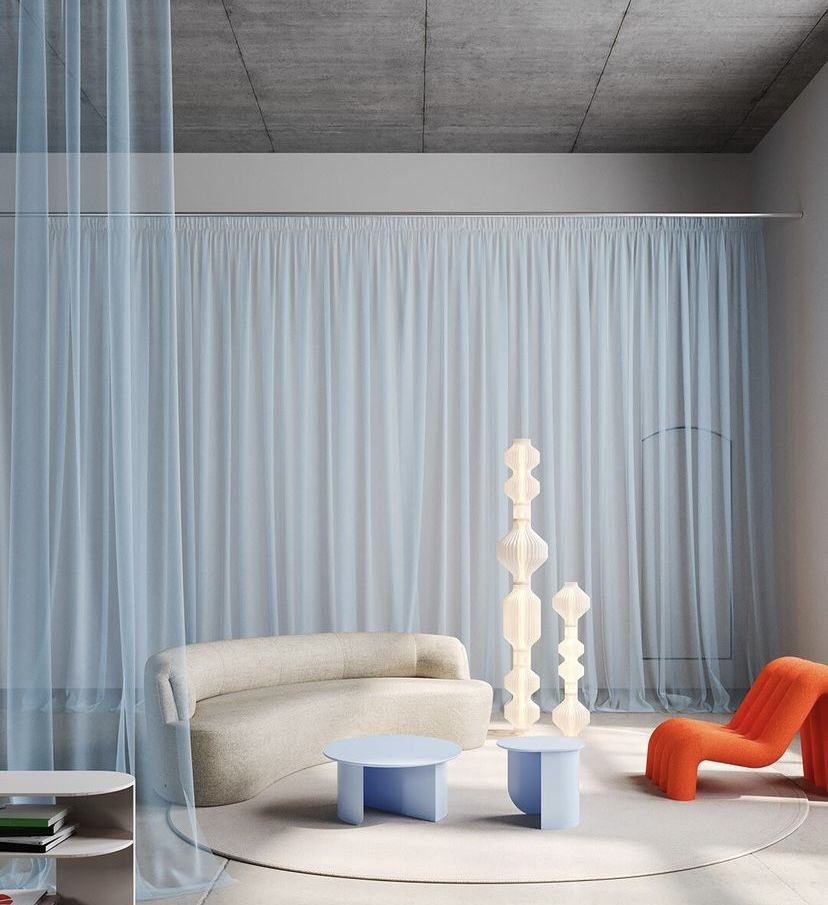
Architecture is not defined exclusively by the physical boundaries we construct, but also by the sensory boundaries we experience. Textiles are among the materials capable of influencing these boundaries without requiring permanent architectural intervention.

This raises a question about the role of materials. If a material changes how sound moves through a room, can it also change the architecture of that room without altering its physical layout?
To explore this, I will draw on Barry Blesser and Linda Ruth Salter's Spaces Speak, Are You Listening? Experiencing Aural Architecture, alongside two architectural projects that use textiles to influence spatial experience. My interest is not simply in how textiles improve acoustic comfort, but in what their acoustic properties reveal about the relationship between material, architecture, and human behaviour.
Architecture beyond the visible
Blesser and Salter, who study the acoustic dimensions of spatial perception, explain this phenomenon through the concept of “aural architecture”, a term they use to describe the spatial qualities that emerge from the interaction between sound and the physical environment. Their approach redirects our attention from sound as an isolated environmental phenomenon to the role architecture itself plays in shaping what we hear. A room, therefore, is not merely a container for sound. Its surfaces, proportions, and materials determine how sound is reflected, absorbed, diffused, or sustained.
Consider the difference between entering a stone cathedral and a heavily furnished living room. Even with our eyes closed, we can recognise something about the spaces we occupy. In the cathedral, footsteps and voices may linger through long reverberation. In the living room, upholstered furniture, carpets, and curtains can absorb sound energy, producing a shorter and less reflective acoustic response.
The distinction is not only one of comfort. These spaces communicate different expectations about how we should occupy them. A cathedral's reverberation may encourage stillness or a heightened awareness of collective presence. A furnished domestic interior may support quieter conversations and a sense of intimacy. Neither response is inevitable, but the acoustic character of each environment contributes to the way we interpret and use it.
From an aural perspective, two areas may remain visually connected while being aurally distinct. Similarly, a space can appear physically open while its acoustic character creates a sense of separation.
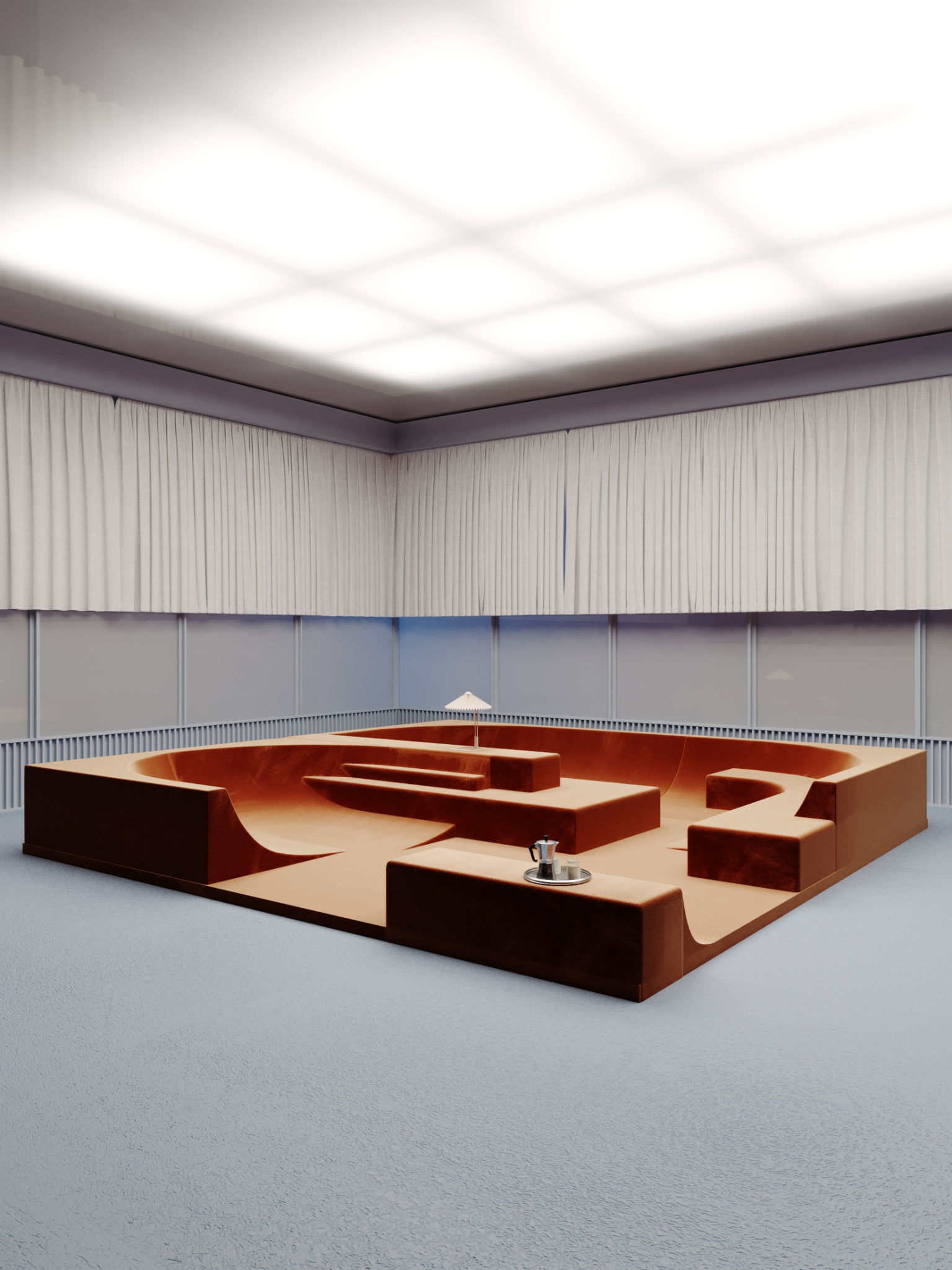
The boundary we see and the boundary we hear are not always the same.
At this point, textiles become particularly interesting as architectural materials.
What materials do to sound
A textile does not need to enclose a space to define its boundaries.
Through its interaction with sound, it can influence how far sound travels, how long it persists, and the extent to which one activity can be heard from another. However, the acoustic effects of textiles are not all the same. Sound absorption, sound insulation and acoustic privacy describe related but distinct phenomena.
When sound encounters a surface, part of its energy may be reflected, part absorbed, and part transmitted through the material or construction. The proportions depend on the frequency of the sound, the properties of the material, and the way it is installed.
Absorptive materials reduce reflected sound energy and can help control reverberation within a room. Sound insulation, by contrast, concerns how much sound passes from one space to another. Acoustic privacy depends on several factors, including sound transmission, distance, background noise and how intelligible speech remains to a listener.
Every interior space possesses a unique acoustic character. Hard surfaces such as glass, stone, and concrete tend to reflect sound, allowing it to move through the space and bounce off surfaces. Textiles, however, behave differently. Their porous and flexible structures can absorb a portion of the acoustic energy that reaches them.
Sound waves entering a fibrous material cause air to move through the small spaces between fibers. Frictional and thermal losses convert part of the acoustic energy into heat. The effectiveness of this process depends on factors including material thickness, airflow resistance, density, frequency, and the presence of an air cavity behind the textile.
A carpet can dampen the sharpness of footsteps, while curtains can soften reflections caused by large glass surfaces.
This is why a thin decorative curtain and a thick acoustic curtain should not be considered equivalent, even if they appear similar.

Blesser and Salter discuss how sound absorption can create smaller auditory zones within a larger architectural space. Materials such as carpets, heavy curtains, and upholstered furniture can reduce reflections, enabling different sections of an interior to develop their own distinct acoustic characters. In this sense, sound absorption is not merely about controlling noise. It can reshape the way a space is experienced.
An absorbent textile may improve the acoustic conditions of a room without preventing conversations from being heard elsewhere. A curtain can soften reverberation while still allowing speech to pass through it. This distinction matters because architectural materials are often discussed as though improving acoustics automatically produces privacy. It does not.
Yet this limitation does not diminish the architectural potential of textiles. Instead, it invites a more precise understanding of what they can accomplish.
Textile materials within a space help determine how far sound travels, where it is interrupted, and how long it remains perceptible. Thus, their architectural impact is not only spatial but also temporal. Auditory boundaries also possess a social dimension.
The social consequences of sound

Imagine entering a restaurant with an open floor plan, high ceilings, polished concrete floors, and large glass windows. Visually, the interior communicates openness and sociability. Tables are arranged to encourage interaction, and the absence of partitions allows the entire room to be perceived at once.
But the acoustic experience may tell a different story. As the restaurant fills, conversations begin to overlap. Guests raise their voices to remain intelligible over surrounding speech. Increasing vocal effort contributes to higher background noise, encouraging others to speak louder in response. This phenomenon is associated with the Lombard effect, the tendency to increase vocal intensity in noisy environments.
The architecture intended to encourage social interaction may therefore create conditions that make interaction more difficult.
Now imagine introducing upholstered seating, suspended acoustic textiles, and absorbent wall treatments. The floor plan remains unchanged. The number of tables is identical. The visual connections between different areas may remain largely intact.
Yet the acoustic character can change. Reducing reflected sound can improve speech clarity and lower the accumulation of reverberant noise. Guests may find it easier to converse without raising their voices. Depending on the arrangement and acoustic performance of the materials, some areas may feel more sheltered than others.
The ability or inability to hear another person influences how we use a space. A room with uncontrolled reverberation can cause conversations and movements to carry across a wider area than intended. Conversely, an acoustically controlled environment can foster focus, privacy, or quieter forms of interaction.
People may lower their voices, avoid a conversation, move away from others or seek a more sheltered corner when they feel too exposed to the sounds around them. Although these responses are not determined by materials alone, acoustic conditions can influence how people use and experience a space.
This raises an interesting contradiction. We often assume that architecture directs behaviour through physical organisation. A corridor tells us where to walk. A door indicates where we may enter. A partition establishes where one activity ends and another begins. But materials can influence behaviour without providing such explicit instructions.
This becomes particularly significant in spaces that host multiple simultaneous activities. Libraries, schools, workspaces, cultural venues, and residential interiors often need to remain flexible while accommodating varying degrees of interaction. Permanent partitions may not always be the optimal solution.
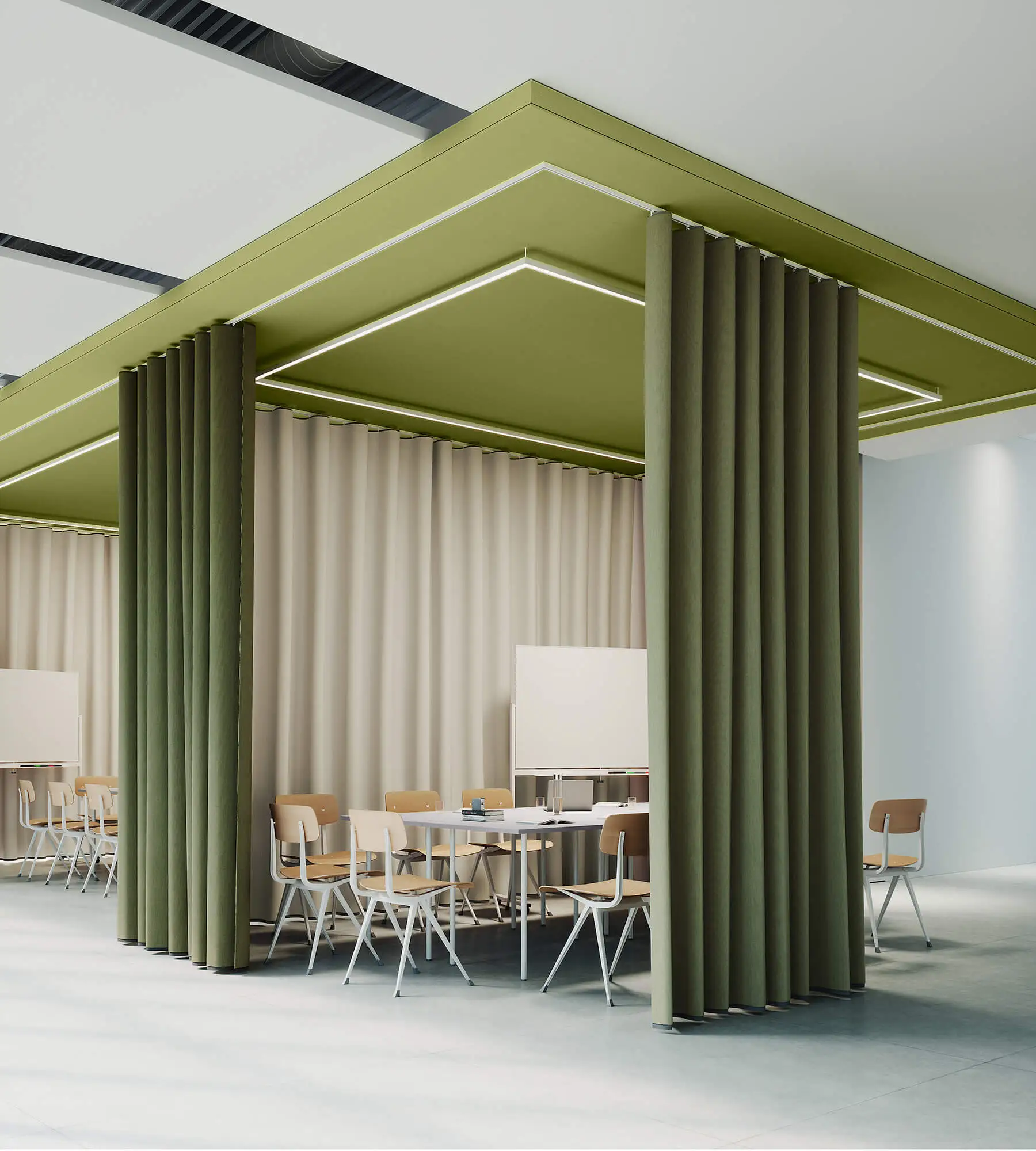
Textiles can offer alternative possibilities here. They can contribute to acoustic privacy, help distinguish one area from another, and soften the acoustic relationship between people sharing the same room. Such interventions are virtually invisible on an architectural plan, yet they influence who can hear whom, where a conversation feels private, and how far an activity’s sound extends into its surroundings.
Can materials influence how people behave without explicitly directing their behaviour? A textile does not tell someone to speak quietly or move away from a conversation. Yet, by altering the acoustic conditions and sense of exposure within a space, it may help create circumstances in which certain behaviours become more comfortable than others.
I would argue that materials can influence behaviour, although their influence is indirect. They do not prescribe our actions. Instead, they change the sensory conditions in which our decisions are made.
When textiles become architecture
Two projects offer different ways to examine this relationship between textile, acoustic performance and spatial division.
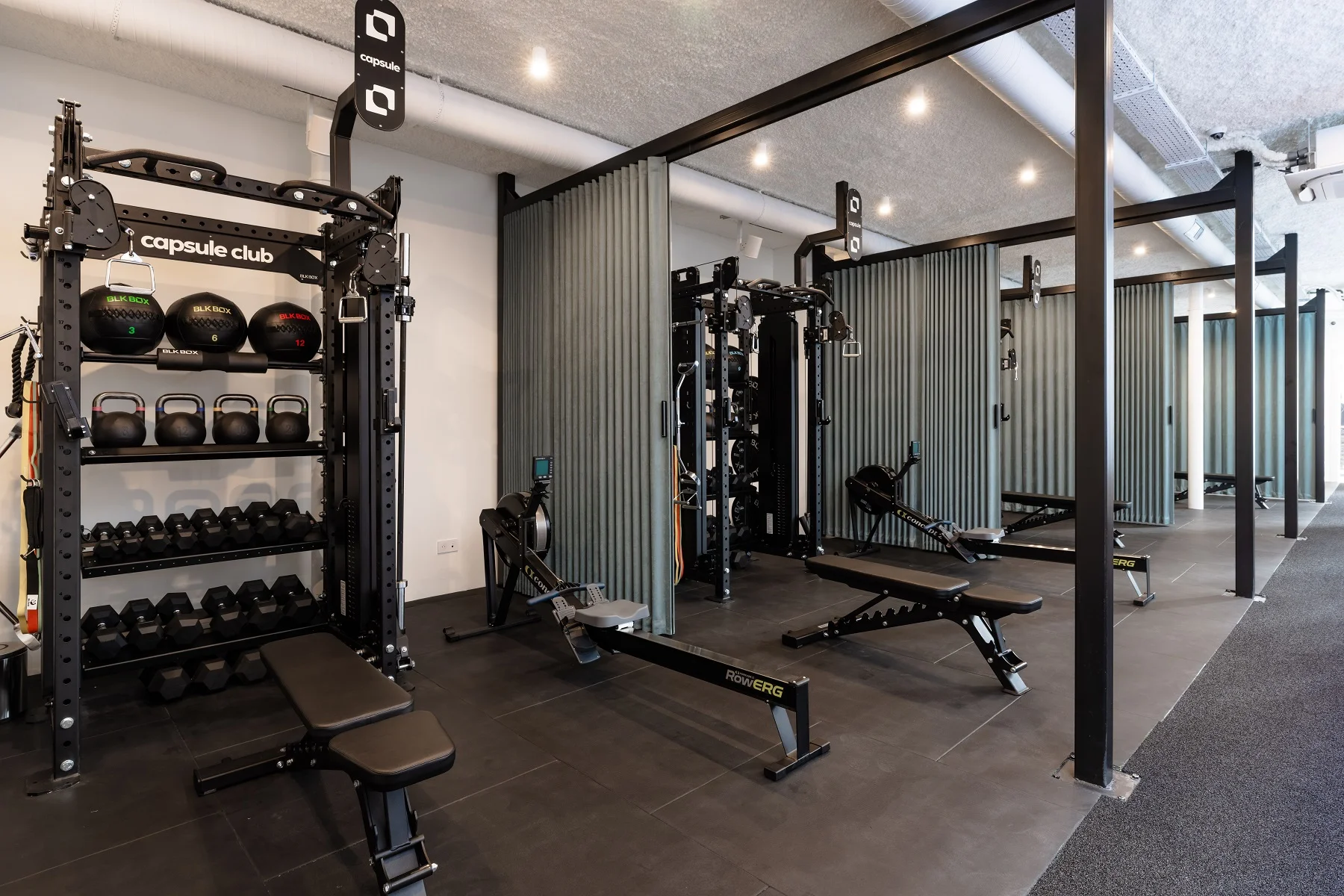
Waves, developed by Kvadrat Acoustics in collaboration with Foster and Partners Industrial Design, is a multilayered acoustic curtain system designed for open plan interiors. Its flexible configuration allows areas to be formed and reconfigured without introducing permanent walls. The system combines textile layers with an internal sound-reducing layer and is designed to reduce sound transmission as well as improve acoustic comfort. Waves therefore offers an example of a curtain system whose purpose extends beyond softening sound reflections.
What interests me here is the relationship between acoustic performance and spatial flexibility. A drawn curtain can help create a more sheltered area within an open interior, while opening it allows the division to recede. The boundary changes with the arrangement of the textile and the activities taking place around it.
A conventional partition establishes a relatively fixed spatial arrangement. Waves introduce a boundary that can respond to the changing activities of an interior. The significance of this is not simply that the curtain can be moved, but that the acoustic relationship between spaces can change with it.
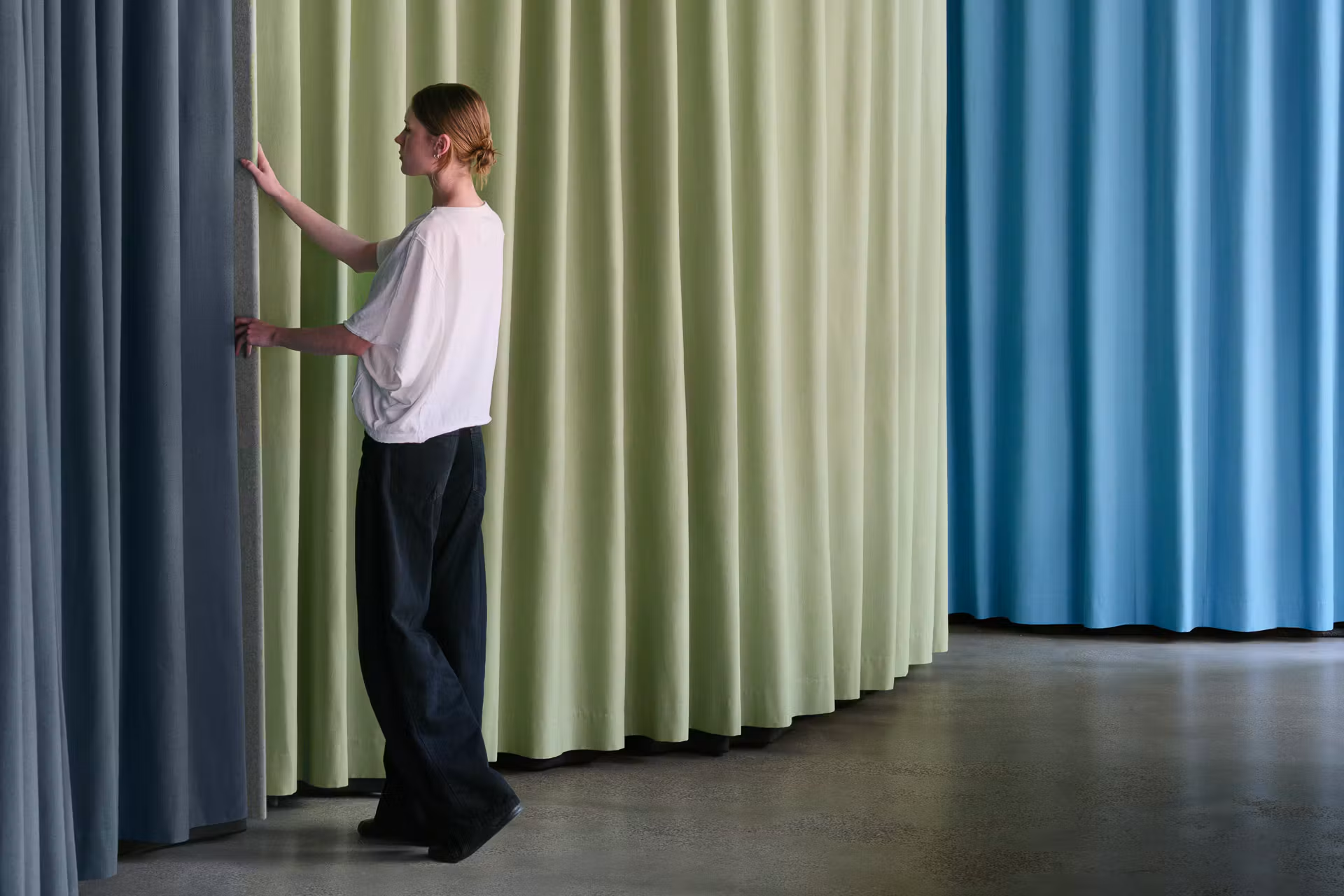
Waves is a purpose-designed acoustic system, however, and its performance should not be assumed of ordinary curtains.
Its effectiveness also depends on installation, construction, edge conditions, and the paths through which sound can travel around the curtain. A textile partition cannot automatically replace the acoustic isolation of a fully sealed architectural wall.
Perhaps this is precisely what makes the project interesting. It does not attempt to reproduce every property of a permanent partition. Instead, it proposes another way of negotiating separation, connection, and flexibility.
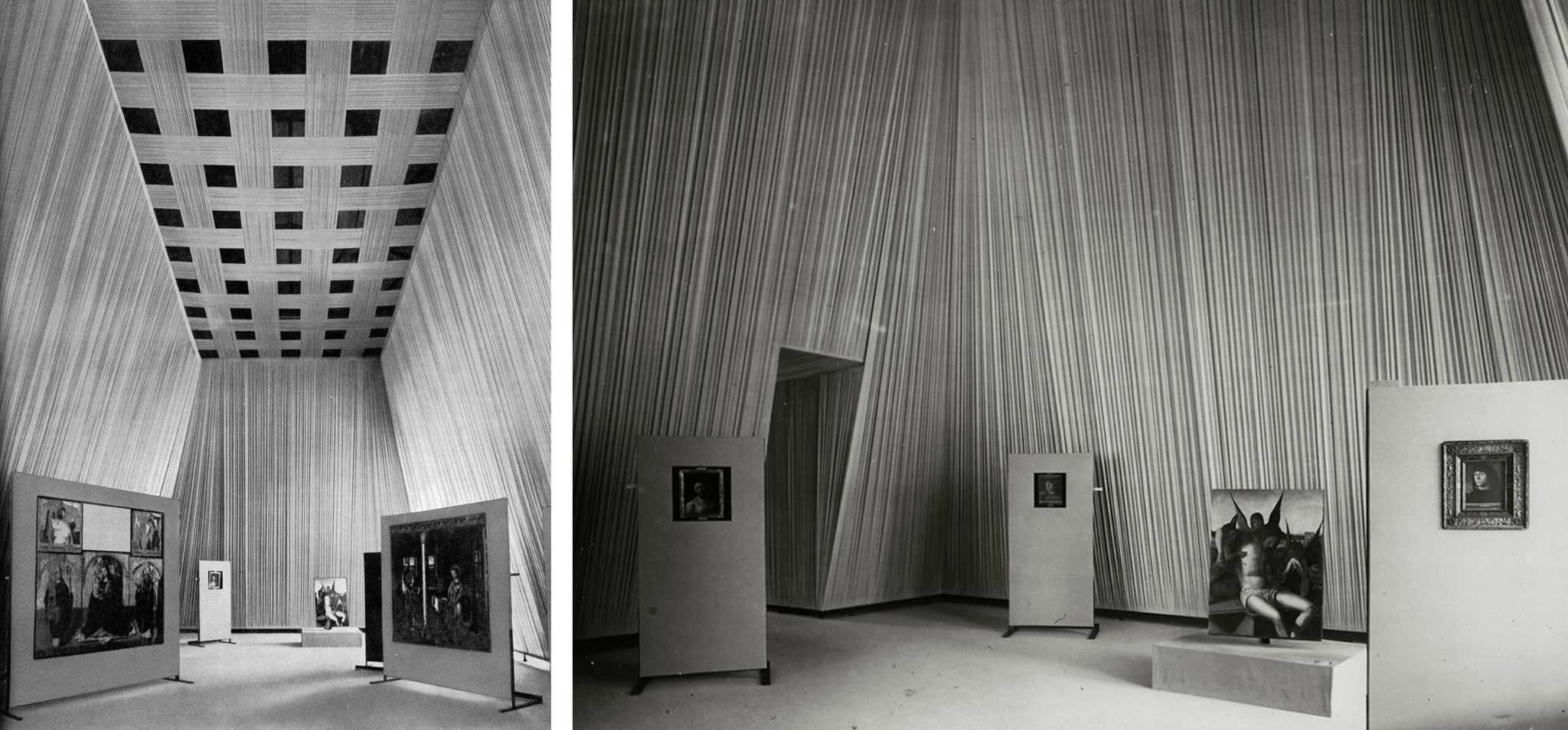
Textile Spaces, by Sylvie Krüger, offers a different perspective. Specially developed curtains allow a conference room in an administration building to be divided into different configurations, accommodating uses ranging from small meetings to larger conferences. The heavy, double hanging textiles are intended to improve room acoustics and reduce noise. The project explores how opening and closing a textile division can support different forms of communication and withdrawal.
A conference room is fundamentally a space for communication. Its success depends not only on how many people it accommodates, but also on whether those people can hear one another, participate in discussions, or withdraw into smaller groups.
A large meeting may require a shared acoustic environment, while several smaller discussions may benefit from greater separation. The curtains help negotiate these conditions without permanently fixing the room into one configuration.
However, heavy curtains do not necessarily provide the confidentiality of a fully enclosed meeting room. Their acoustic performance depends on their construction and installation, and reducing reverberation should not be confused with preventing sound transmission.

Where Waves foregrounds a purpose-designed acoustic curtain system, Textile Spaces draws attention to the changing relationship between a room and the activities it accommodates. Both projects show how textiles can participate in organising spatial use without functioning as fixed walls. Rather than making textile equivalent to a solid partition, they demonstrate how a flexible material can help shape different spatial and acoustic conditions.
Both projects also suggest that a boundary does not need to be permanent to have architectural significance. The question is not whether a textile can perform every function of a wall, but whether permanence should be the defining characteristic of an architectural boundary.
The boundary as an experience
Thus, the boundary becomes relational. It is not merely a matter of where one space ends and another begins. It is also about how far an experience can reach. Architectural boundaries are commonly understood as elements that separate one space from another. They divide interior from exterior, public from private, and one activity from the next. But these distinctions are not always absolute.
A space can be visually open while offering some degree of acoustic shelter. It can be physically enclosed while remaining acoustically exposed. A textile can provide a sense of separation without producing complete isolation. The boundary becomes something negotiated through perception rather than determined exclusively by construction.
This also introduces a temporal dimension to architecture. A wall generally remains in place regardless of how a room is occupied. A textile curtain can be drawn or opened, changing the relationship between activities over time. Sound itself is temporal, appearing, travelling, reflecting, and eventually decaying.
The architecture we hear is therefore never entirely static.
A room sounds different when empty and when occupied. It changes when people begin speaking, when furniture is rearranged, or when a curtain is drawn. Its acoustic identity emerges from the interaction between materials, activities, and the people who inhabit it. Blesser and Salter remind us that spaces experienced through listening are not secondary to those experienced through sight. They represent another dimension of the architectural experience. Once this is recognized, materials often regarded as merely decorative or temporary can be reimagined as active participants in the production of space. Textiles are often described as additions to architecture, materials introduced after the essential spatial organisation has already been established. Carpets, curtains, and upholstery are frequently considered part of the interior rather than the architecture itself.
But if these materials influence how sound travels, how conversations are experienced, and how people relate to one another within a space, can they really be regarded as secondary?
Their influence may be less permanent than that of concrete or masonry, but permanence is not the only measure of architectural significance.
Perhaps the more interesting question is not whether textiles can replace conventional architectural boundaries, but why we continue to define those boundaries primarily through what we can see.
If architecture is also produced through listening, then the materials that shape our acoustic experience are not simply furnishing a space. They are helping to define it. The invisible architecture of sound already exists around us. The question is whether we are willing to recognise the materials that construct it.
References
- Blesser, B., & Salter, L. R. (2007). Spaces Speak, Are You Listening? Experiencing Aural Architecture. MIT Press.
- Textile Spaces, Sylvie Krüger. divisare.com
- Waves, Kvadrat Acoustics. kvadrat.dk
About the author
Deniz Altindag is an architect and PhD researcher at Universitat Oberta de Catalunya in Barcelona. Her research explores creative-critical mapping, storytelling, spatial memory, and the relationship between play and space. She is also the co-founder of Light and Memory: Art, Design Education & Research Lab and a member of the Advisory Board at Play England. Her work brings together architecture, design, education, and creative research to explore how spaces shape memory, experience, and everyday life.